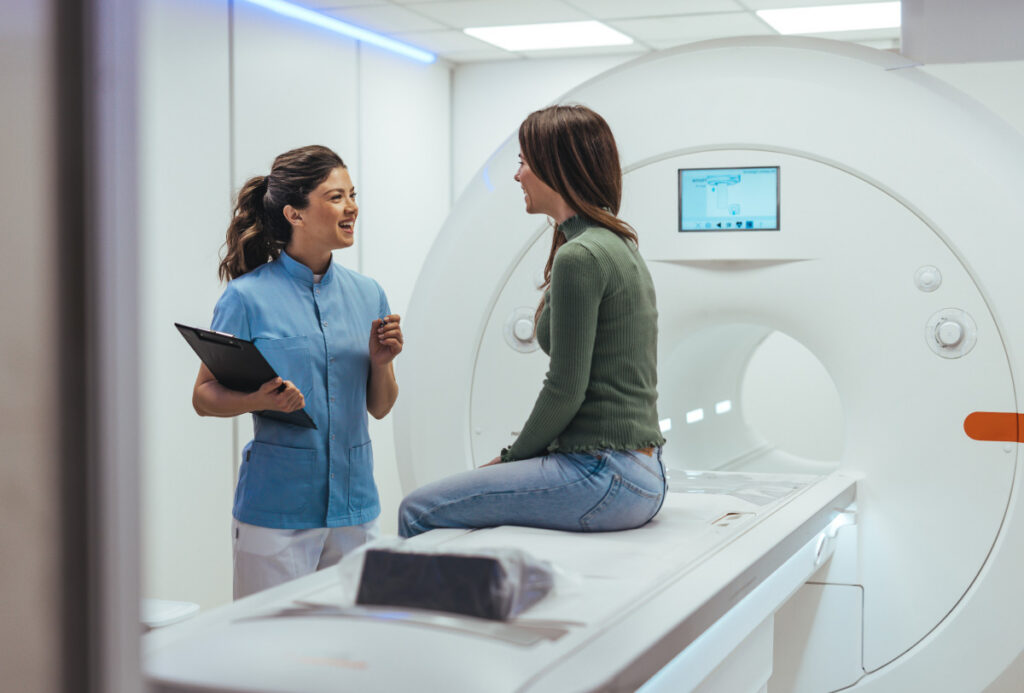
Learning that you need an imaging test often brings up questions about safety. One of the most common concerns is whether MRI uses radiation. Does MRI have radiation? No. MRI uses a powerful magnet and radio waves to gather signals from your body. A computer then turns those signals into detailed pictures. You get clear answers about your health without the ionizing radiation used in X-rays and CT scans.
Below, we’ll explain how MRI works, how safe the imaging really is and what to expect at your appointment. Knowing the facts can help you feel confident about your next step.
What Is MRI?
MRI stands for “magnetic resonance imaging.” This advanced imaging test can take detailed pictures of almost any part of your body. It’s non-invasive, which means it doesn’t require surgery or incisions.
What makes MRI imaging helpful is the detail it shows in soft tissue, such as muscles, ligaments, tendons and nerves. It can reveal small differences between healthy tissue and areas affected by injury or disease. That’s why doctors rely on MRI as the preferred imaging test for many conditions.
With these clear images, your doctor can get to the root of your symptoms and plan the right care for you.
Is There Radiation in an MRI?
MRI uses a strong magnetic field and radio waves to create detailed pictures of the inside of your body. Unlike X-rays and CT scans, MRI doesn’t use ionizing radiation.
The magnetic field and radio waves affect hydrogen atoms found in the water and fat in your body. As the hydrogen atoms respond, they produce signals that the scanner detects. A computer uses the signals to create detailed images of your organs, muscles and other tissues. Because different tissues produce different signals, MRI can help your radiologist identify injuries, swelling and other changes clearly.
Is Radiation Exposure From MRI Something Patients Need to Worry About?
MRI doesn’t use ionizing radiation. The magnetic fields and radio waves used during an MRI aren’t known to harm body tissues when proper safety precautions are followed.
The main safety concern with MRI is its powerful magnet, which can affect certain metals, implants and medical devices. Before your scan, your care team will ask about any metal or medical devices in your body to make sure MRI is safe for you. The MRI magnet is always on, even when no scan is running, so metal items must stay outside the scan room.
During your scan, you may feel mild warmth in the area being scanned as your body absorbs energy from the radio waves. This is normal and usually goes away shortly after the scan.
Because MRI doesn’t expose you to ionizing radiation, it can be used during pregnancy when your care team decides it’s needed. Gadolinium contrast dye is generally avoided during pregnancy. If you’re pregnant or think you might be, tell your doctor and imaging team before scheduling. Your care team will decide whether MRI is right for you.
Are Repeated MRI Scans Safe?
Because MRI doesn’t use ionizing radiation, there’s no radiation buildup from repeated scans. This makes MRI a painless, useful option for monitoring conditions that require regular imaging.
Your doctor may recommend follow-up MRIs to:
- Track how an injury or surgical site is healing
- Monitor an ongoing condition, such as multiple sclerosis
- Check whether a tumor or growth has changed
- See how well your treatment is working
If your MRI requires contrast dye, your doctor will consider whether it’s needed for each exam, along with factors such as your kidney health and any previous reactions to contrast. Let your care team know if you’ve had an MRI before. Comparing new images with earlier scans can help your radiologist identify changes and give your doctor a clearer picture of your health over time.
Will You Feel Sick After an MRI?
Most people feel completely normal after an MRI and can get back to their day right away. The magnetic field and radio waves stop when your scan ends, and they don’t leave anything behind in your body.
If your exam used contrast dye, side effects are uncommon and usually mild, such as a brief headache or nausea. Your kidneys naturally clear the contrast from your body, usually within about a day.
You may feel a little stiff from lying still, but this usually fades once you start moving. If your doctor prescribed a mild sedative to help you relax, you may feel drowsy, so arrange a ride home ahead of time. If you notice any unusual symptoms after your scan, contact your doctor.
Why Do Some People Confuse MRI With CT or X-Ray Radiation?
MRI is often grouped with X-rays and CT scans because all three are imaging tests used to look inside the body. MRI and CT scanners can even look similar. Both use a large, ring-shaped machine and a table that moves you into position. Both tests also create detailed, cross-sectional images of the body. However, the main difference between MRI and CT scans is how they produce those images.
X-rays and CT scans use small, controlled amounts of ionizing radiation. A standard X-ray produces a flat image, while a CT scan uses multiple X-ray images to create detailed views of the body’s internal structures. At American Health Imaging, low-dose CT protocols and digital X-ray technology, available at select centers, help keep radiation exposure as low as reasonably possible.
Your doctor will recommend an MRI or CT scan based on the part of your body being examined and the condition they’re looking for.
What’s It Like To Get an MRI?
Your MRI technologist will explain what to expect before the scan begins. Here’s how the process usually works:
- Safety screening: Your technologist will review your medical history and safety screening form, check for metal or medical devices, and answer any questions you have.
- Getting ready: You’ll usually change into a gown and leave your personal belongings in a secure area outside the scan room.
- Positioning: You’ll lie on a padded table with cushions to help you stay comfortable. The table will slide into the scanner, which is open at both ends.
- Imaging: The scanner makes loud tapping and knocking sounds as it takes images. You’ll receive earplugs or headphones to protect your hearing. Music may also be available to help you relax. You’ll need to lie still and breathe normally, although some scans require you to hold your breath briefly.
- Using contrast: Some MRI exams require contrast dye to make certain tissues easier to see. If your exam requires contrast, a technologist will give it through a small IV, usually in your arm.
Your technologist will be in a nearby room throughout the scan but can see, hear and speak with you at all times. You’ll also have a call button to let your technologist know if you need assistance.
When Do You Need an MRI Scan?
Your doctor may recommend an MRI to get a detailed look at your body’s soft tissues, find the cause of symptoms or monitor a known medical condition.
Common reasons for an MRI include:
- Back or neck pain: Ongoing pain, numbness, tingling or weakness that may be caused by a herniated disc or pinched nerve.
- Joint pain or injuries: Pain or injuries affecting the knees, shoulders, hips, wrists or ankles, including sports injuries.
- Brain or nervous system conditions: Frequent headaches, changes in vision or balance, multiple sclerosis, or damage caused by a stroke.
- Tumors or unusual growths: Finding growths, checking for changes or seeing how well treatment is working.
- Infections or inflammation: Looking for signs of infection or inflammation in organs, bones or soft tissues.
- Other health concerns: Examining the abdomen, pelvis, breasts, heart or blood vessels for certain medical conditions.
If you have ongoing pain or other symptoms that affect your daily life, talk with your doctor about whether an MRI could help find the cause.
Schedule Your MRI Today
Getting answers about your health shouldn’t add to your worries. MRI provides detailed images of the inside of your body without exposing you to radiation.
At American Health Imaging, a board-certified, subspecialized radiologist reads your exam and provides detailed findings to help your doctor make decisions about your care. We’re in-network with 99% of major insurance plans, our MRI scans cost up to 60% less than hospital imaging and we have a 97% patient satisfaction rating. Same-day appointments are available, and extended and weekend hours are offered at select locations.
Talk to your doctor about imaging. When you’re ready, request an appointment at American Health Imaging. Our team is here to help you feel comfortable as you take the next step toward getting answers about your health.
Frequently Asked Questions About MRI Scans
Unless your doctor tells you otherwise, you can eat, drink and take your usual medications before your MRI. Leave jewelry, watches and other metal items at home. Avoid makeup, nail polish and hair products that may contain metal particles. Tell your imaging team about any implants or medical devices, and bring the device information if you have it.
Follow any instructions provided before your appointment. If you're uncomfortable in small spaces, let us know when you schedule so we can match you with the most comfortable machine available. Most of our locations offer wide-bore MRI, and open MRI is available at select centers.
After your MRI, a radiologist will review your images and send a report to your doctor, who'll explain the results and any next steps.
At American Health Imaging, you'll also receive a Scanslated® report by text within 48 hours after your report is finalized. The text includes a link to your patient-friendly report with clear explanations and diagrams to help you understand your results.
MRI is safe for most people, but certain implants, medical devices and metal fragments may pose safety risks. These include some pacemakers, aneurysm clips, cochlear implants and implanted pumps.
Many newer devices are compatible with MRI under specific conditions. Your imaging team will review your medical history and device information to determine whether MRI is safe for you. If MRI isn't an option, your doctor may recommend CT or ultrasound instead.
Your doctor may recommend MRI contrast to make certain tissues, blood vessels or areas of inflammation easier to see. Tell your care team if you have kidney disease, have had a reaction to MRI contrast or are pregnant.
Most MRI scans take 30 to 60 minutes, depending on the area being examined and the images needed.
At American Health Imaging, faster scanning MRI technology, available at many of our locations, reduces many scan times to as little as 8 minutes. Your technologist will explain how long your scan should take. Plan for extra time to check in and complete your safety screening.
Every American Health Imaging center offers MRI, so you can choose the location that fits your schedule. Our centers serve communities in Georgia, Alabama, South Carolina, Tallahassee, FL, San Antonio, TX and Beaumont, TX.