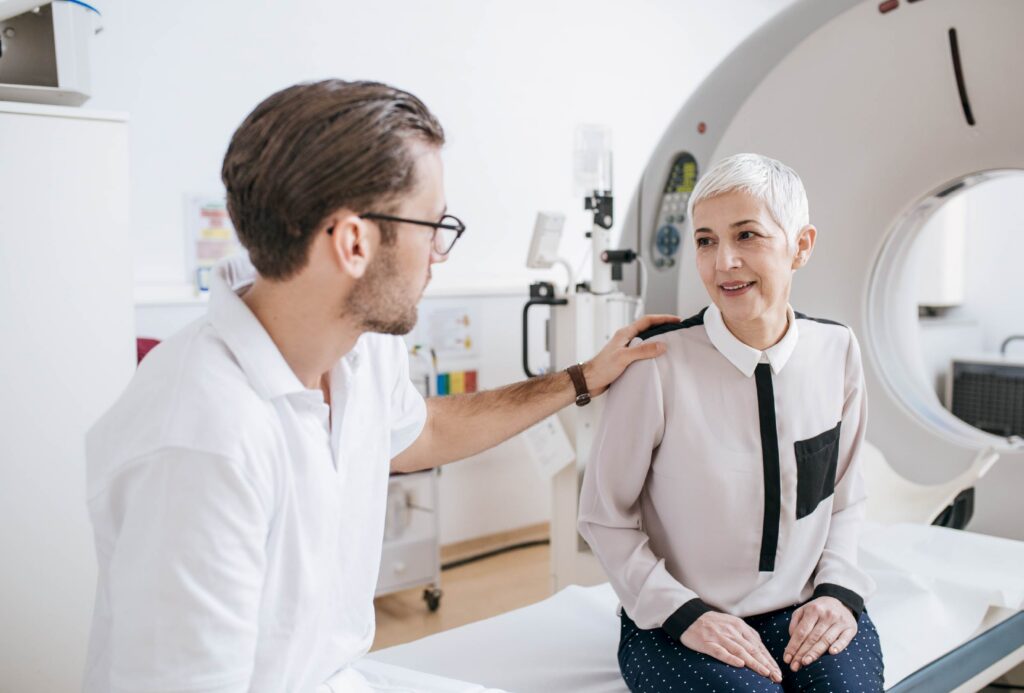
A CT scan, or computed tomography scan, is one of the most detailed and widely used imaging tools available for detecting and monitoring cancer. CT scans are highly accurate for finding many types of cancer, especially in solid organs like the lungs, liver, kidneys and colon.
This guide explains how CT scans detect cancer and what types of cancer they can identify. Learn how accurate a CT scan is for different cancers and how American Health Imaging can help you get the clear answers you need.
Can a CT Scan Detect Cancer?
CT scans can detect cancer by creating detailed cross-sectional images, or slices, of the inside of your body. CT technology combines multiple X-ray pictures taken from different angles to show bones, organs and soft tissues far more clearly than a standard X-ray. These slices can also be combined into three-dimensional views, giving your doctor a more complete picture of what is happening inside your body and helping your care team take the right next step in your care.
A CT scan is so detailed that it can show the size, shape and location of a tumor, along with nearby blood vessels and surrounding tissues. CT imaging can also reveal whether a cancer has spread, or metastasized, to other parts of the body. This makes it a powerful tool not only for initial detection but for understanding how advanced a cancer may be.
How Accurate Are CT Scans for Cancer?
CT scans are highly accurate for detecting many types of cancer. That said, accuracy can vary depending on the type of cancer, its size and its location in the body.
CT imaging is especially effective for cancers that affect dense organs such as the lungs, liver, kidneys, pancreas and colon. CT can show the precise size and location of tumors in your organs and reveal whether the disease has spread to nearby lymph nodes or more distant areas of the body.
Lung Cancer
Some cancers are easier to detect with CT than others. Lung cancer, for example, is well-detected by CT, and low-dose CT lung screening has been proven to reduce lung cancer deaths in high-risk individuals.
Colorectal Cancer
Colorectal cancer can also be evaluated using CT colonography, which provides a detailed look at the colon without a traditional scope. This test can help identify polyps, growths or other abnormalities that may need follow-up with a traditional colonoscopy.
Abdominal Cancers
Kidney, liver and pancreatic cancers are also well-suited to CT evaluation because the technology gives doctors a clear look at deep abdominal organs, including abnormal masses, enlarged lymph nodes and signs that cancer may have spread nearby.
Your doctor will choose the imaging test that best fits your symptoms and what they need to evaluate. When used as part of a complete diagnostic approach, CT scanning remains one of the most powerful and widely trusted tools for cancer detection available today.
Does a CT Scan With Contrast Show All Cancers?
Contrast dye is a special substance that helps blood vessels, organs and tissues appear more clearly on a CT scan. The dye can be swallowed as a liquid, injected into a vein or given as an enema, depending on which area of the body is being scanned.
IV contrast, in particular, can provide added detail for a more precise evaluation of how tumors relate to surrounding tissues and organs. This is especially useful for detecting tumors that are harder to see without contrast and for evaluating how a cancer is responding to treatment.
Very small tumors, some early-stage cancers or tumors near the brain, spine or dense soft tissues may still require additional imaging or follow-up testing to confirm a diagnosis. Your doctor will use the CT results along with your symptoms, medical history and any other needed tests to determine whether you need more imaging, a biopsy, treatment or continued monitoring.
What Is CT-Guided Biopsy?
When a CT scan identifies a suspicious area, your doctor may recommend a biopsy to gather more information. A CT-guided biopsy uses real-time CT imaging to help your care team pinpoint the exact location of a tumor or abnormal tissue and guide a needle precisely to that spot to collect a small sample for testing.
Because CT imaging shows detailed, cross-sectional views of the body, it gives your doctor the accuracy needed to reach areas that would be difficult to access otherwise. This makes the procedure more targeted and more efficient than approaches that rely on less detailed imaging.
A CT-guided biopsy is minimally invasive and is typically performed on an outpatient basis, meaning no overnight hospital stay is needed. The tissue sample collected is then sent to a laboratory, where it can be analyzed to determine whether cells are cancerous and help guide the next step in your care.
Getting a clear answer about a suspicious finding is an important part of taking control of your health. CT-guided biopsy gives your doctor the precision they need to move forward with confidence.
Can a CT Scan Detect Cancer Early?
CT scans can detect cancer at earlier stages than many other imaging tests, and early detection is one of the most important factors in successful treatment. In some cases, CT imaging can find tumors before symptoms ever appear, giving patients a critical head start in their treatment.
One of the most significant advances in early cancer detection is low-dose CT lung screening. This specialized scan is designed to detect lung cancer early in people at high risk, particularly those with a significant smoking history. Lung cancer is the leading cause of cancer deaths in the United States, and catching it early makes a measurable difference in outcomes.
Low-dose CT lung screening creates detailed cross-sectional images of the lungs. The technology is sensitive enough to detect nodules as small as a grain of rice.
American Health Imaging offers low-dose CT lung screening for adults aged 50 to 80 who have at least 20 pack-years of smoking history and currently smoke or have quit within the past 15 years.
If you have a smoking history and haven’t yet been screened, talking to your doctor about low-dose CT lung screening could be one of the most important health choices you make.
What Does Cancer on a CT Scan Look Like?
You can see cancer on a CT scan in a number of ways, depending on its type and location. Tumors typically show up as areas of tissue that look different from the healthy structures around them. Radiologists are trained to evaluate these differences carefully and interpret what they mean.
Common signs of cancer on a CT scan may include:
- A solid mass or lump with defined or irregular edges
- An area of unusual density compared to the surrounding tissue
- Small nodules, which are round or oval spots, in organs
- Thickening of the organ walls
- Enlarged lymph nodes near a suspected tumor site
Not every unusual finding on a CT scan is cancer. Benign growths, old scar tissue, inflammation and other non-cancerous conditions can also appear on imaging. This is why every scan at American Health Imaging is read by a board-certified, subspecialized radiologist who provides your doctor with a detailed and expert interpretation. You and your doctor can feel confident in the results when you choose a provider committed to diagnostic accuracy.
How Is a CT Scan Used in Cancer Treatment?
CT scans play a key role throughout every stage of the cancer journey, from initial detection to ongoing monitoring. Here are some of the ways CT scans support cancer treatment:
- Staging: CT scans help determine how advanced a cancer is by showing whether it has spread to nearby lymph nodes or distant organs. Accurate staging helps your doctor choose the right treatment path.
- Radiation Therapy Planning: CT imaging provides the precise measurements and anatomical detail that doctors need to plan where and how to deliver radiation treatment.
- Guiding Procedures: CT scans are used in real time to guide biopsies and localized cancer treatments such as radiofrequency ablation, a technique that uses heat to destroy a tumor.
- Monitoring Treatment Response: By comparing CT scans taken at different points in time, your doctor can evaluate whether a tumor is shrinking, staying stable or changing in response to treatment.
After treatment is complete, CT scans are often part of follow-up care to check whether cancer has returned.
Schedule a CT Scan at American Health Imaging
Choosing clarity about your health starts with choosing the right imaging provider. American Health Imaging offers precision CT imaging read by board-certified, subspecialized radiologists at up to 60% less than hospital-based imaging. We’re in-network with 99% of insurance plans and have a 97% patient satisfaction rating.
With same-day and next-day appointments, extended hours and convenient locations across Georgia, Alabama, Texas, South Carolina and Florida, your imaging team is ready to help you get the answers you need.
Talk to your doctor about imaging and schedule your CT scan with American Health Imaging today.
Frequently Asked Questions About CT Scans for Cancer
A CT scan can identify the size, shape and location of a tumor and provide important clues about whether it may be cancerous. However, a CT scan alone cannot confirm a cancer diagnosis.
If a finding looks suspicious, your doctor may recommend a biopsy to collect a tissue sample and determine definitively whether a tumor is cancerous. CT-guided biopsies allow your doctor to pinpoint exactly where the biopsy should be taken.
Advanced multi-slice CT technology can detect tumors and nodules just a few millimeters in size. Low-dose CT lung screening, for example, can detect lung nodules as small as a grain of rice. The size of the tumor that can be detected may vary depending on the type of scan, the area of the body being imaged and whether contrast dye is used.
Both CT scans and MRIs are advanced imaging tools, and each has specific strengths. CT scans are fast, widely available and particularly effective for evaluating solid organs, bones and the chest.
MRI provides highly detailed images of soft tissues and is often preferred for brain, spinal cord and musculoskeletal cancers. Your doctor will choose the imaging test that best fits your specific situation, symptoms and the type of cancer being evaluated.
CT scans are considered safe and are widely used for cancer detection. One concern some patients have is radiation exposure, but modern CT technology uses a low level of radiation. Your doctor will only recommend CT imaging when the information it provides can help guide care.
If a CT scan shows an unusual finding, your doctor will review the results with you and recommend next steps based on what the radiologist found. Depending on the size, appearance and location of the finding, you may need a follow-up CT scan. Your doctor may recommend additional imaging, such as a PET-CT or MRI, or a biopsy to gather more information.
Finding something on a scan is not automatically a cause for alarm. Your care team will guide you through what the finding means and what to do next.
American Health Imaging has convenient imaging centers across Alabama, Georgia, Tallahassee, FL, Beaumont, TX, San Antonio, TX and South Carolina with CT imaging services. All locations offer same-day and next-day appointments, with many locations offering extended hours and weekend availability to make scheduling easy.