If your doctor has ordered CT angiography, understanding what to expect can help you feel prepared before your appointment. Angiography is a type of imaging that gives doctors a detailed look at your blood vessels and how blood is moving through them. CT angiography, or CTA, is one of the most common and advanced forms of angiography, and most appointments take between 20 and 60 minutes from check-in to completion.
In this guide, you’ll learn more about how long CT angiography takes, how to prepare for the procedure and what conditions a CT angiogram can help your doctor identify.
What Is Angiography?
Angiography is a medical imaging technique that allows your doctor to examine blood vessels throughout your body. The set of images produced during this test is called an angiogram. Many angiography exams use contrast dye to make blood vessels clearly visible on imaging scans, giving your care team a detailed picture of how blood is flowing and where any problems may exist.
There are a few common types of angiography:
- Catheter angiography uses a thin, flexible tube inserted directly into a blood vessel to deliver contrast dye and capture real-time X-ray images of blood flow.
- CT angiography, or CTA, combines a contrast dye injection with a CT scan to produce fast, highly detailed 3D images of blood vessels.
- MR angiography, or MRA, uses an MRI scan to image blood vessels with soft-tissue detail, which can help evaluate the vessel walls.
Your doctor will choose the imaging method that best fits the area being examined, your symptoms and the information needed to guide your care.
What Is CT Angiography?
CT angiography is a non-invasive imaging test that uses a CT scan with contrast dye to produce highly detailed images of your blood vessels and surrounding tissues. During the exam, contrast dye is injected through a small IV line placed in your arm. The dye flows through your blood vessels and makes them appear bright on the CT images, giving your doctor a clear and accurate view of what is happening inside your body.
During a CT angiogram, the CT scanner takes multiple cross-sectional images, or “slices,” of the area being examined. A computer combines these slices into detailed images that your doctor can review closely.
In some cases, these images can also be used to produce 3D reconstructions that show the structure of your blood vessels in greater detail. This level of detail allows your care team to spot subtle changes in blood vessel structure and flow that other imaging tests may not fully capture.
How Long Does a CT Angiogram Take?
Most CT angiography appointments take between 20 and 60 minutes, including check-in and preparation. The imaging portion usually takes only a few minutes, though timing can vary based on the area being scanned and whether multiple image sets are needed.
Here is a general breakdown of what your CT angiogram appointment may look like:
- Check-in and preparation: 10 to 15 minutes
- IV line placement and contrast injection: 5 to 10 minutes
- CT scanning: 1 to 2 minutes, though the scan may be repeated
- Post-scan observation: 10 to 15 minutes
The team at American Health Imaging works efficiently to make your CT angiography appointment as smooth and comfortable as possible. Many of our locations allow patients to listen to music during imaging, and our technologists communicate with you throughout the entire process.
What Happens During CT Angiography?
When you arrive for your CT angiogram, your care team will place a small IV catheter into a vein in your arm or hand. This is how the contrast dye is delivered during the scan.
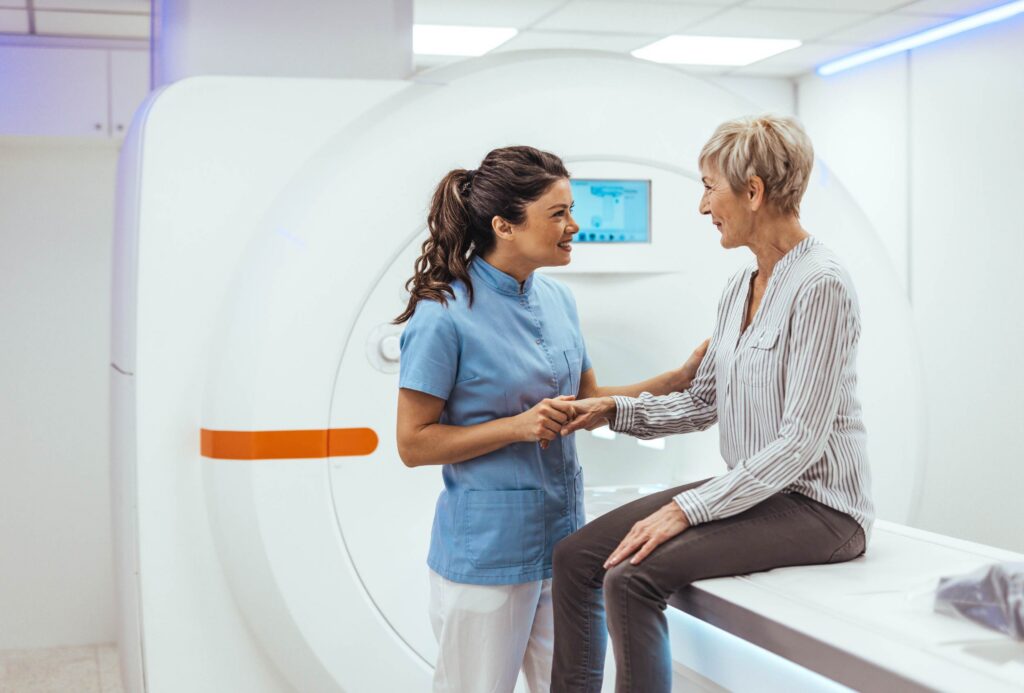
You’ll lie on a cushioned exam table that moves through a large, open, donut-shaped CT scanner. You’re never fully enclosed during the scan. As the contrast dye is injected, you may notice a brief warm sensation throughout your body or a metallic taste in your mouth. These sensations pass quickly and are a normal part of the process.
Your imaging team will guide you through each step and let you know when to hold your breath briefly so the scanner can capture clear, high-quality images.

How Long Does It Take To Recover From CT Angiography?
Recovery time depends on the type of angiography performed. Because CT angiography is non-invasive, most patients feel completely normal right after the procedure and can return to their regular activities the same day.
After your CT angiogram, your care team will observe you briefly before clearing you to go home. The most important thing you can do afterward is drink plenty of fluids. This helps your body flush the contrast dye out of your system. The small IV site in your arm may feel slightly tender for a day or two, but the tenderness typically resolves on its own quickly.
How Should You Prepare for a CT Angiogram?
Preparing for a CT angiogram is straightforward. Here are some general steps to follow before your appointment:
- Wear comfortable, loose-fitting clothing without metal parts, such as zippers or underwire.
- Remove metal objects like jewelry, watches, belts and hairpins before your scan.
- Arrive 15 minutes early with your photo ID, insurance card and a list of your current medications.
- Follow any fasting instructions from your doctor, as some CT angiograms require you to avoid eating or drinking for 4 to 6 hours beforehand.
Tell your care team if you take metformin or have kidney disease, diabetes, heart-related concerns or a previous reaction to iodinated contrast. Also, let your provider know before your appointment if you’re pregnant or breastfeeding.
What Conditions Can Be Diagnosed With a CT Angiogram?
CT angiography is especially effective for identifying conditions that affect how blood moves through your arteries and veins. Conditions that a CT angiogram can help diagnose or evaluate include:
- Aneurysms, or abnormal bulging or widening of a blood vessel
- Blockages or narrowing in the arteries that restrict blood flow
- Blood clots, including those that may travel to the lungs
- Congenital blood vessel abnormalities present from birth
- Vascular malformations, or disorganized and tangled blood vessels
- Arterial injury from trauma
- Tumors or growths near blood vessels
- Tears or splits in the wall of the aorta or its major branches
- Plaque buildup in the carotid arteries or the arteries of the legs
- Pulmonary embolism, or blood clots in the lung arteries
When your doctor needs a comprehensive picture of what’s happening inside your blood vessels, CT angiography can help reduce uncertainty and support a clear, accurate diagnosis.
Schedule Your CT Angiography
Choosing clear answers about your vascular health starts with choosing the right imaging provider. American Health Imaging combines advanced CT technology with exams read by board-certified, subspecialized radiologists to deliver precise imaging you can trust. We’re in-network with 99% of insurance plans and offer savings of up to 60% compared to hospital-based imaging.
American Health Imaging makes getting the answers you need easier, with same-day and next-day appointments available across Georgia, Alabama, Texas, South Carolina, and Florida.
Talk to your doctor about imaging and schedule your CT angiogram with American Health Imaging today.
Frequently Asked Questions About CT Angiography
“Angiography” is the name of the imaging technique used to examine blood vessels, while “angiogram” can refer to the images produced during the test. In everyday conversation, many people use “angiogram” to describe the imaging test itself. Whether your doctor says you need angiography or an angiogram, they’re usually referring to the same type of imaging appointment.
Contrast dye is an essential part of CT angiography. It’s injected through a small IV line in your arm and travels through your blood vessels, making them appear bright and clearly visible on CT images. This is what allows your doctor to get such a detailed look at your vascular system.
You remain awake during a CT angiogram. Sedation isn’t typically required. You’ll be comfortable and able to communicate with your imaging team throughout the entire scan.
CT angiography is considered a safe and widely used imaging procedure. Some people may be concerned that CT scans use radiation, but modern CT technology uses low-dose radiation. CT protocols are designed to keep exposure as low as possible while maintaining image quality.
If you have any concerns about allergies to contrast dye or other medical conditions, be sure to discuss them with your care team before your appointment.
After your CT angiogram at American Health Imaging, a board-certified, subspecialized radiologist reviews your images and sends the results to your doctor. AHI also texts you a link to an easy-to-read imaging report 48 hours after your exam is read, with clear explanations to help you better understand your results.
American Health Imaging has convenient imaging centers across Alabama, Georgia, Tallahassee, FL, Beaumont, TX, San Antonio, TX and South Carolina with CT imaging services, with almost all centers offering CT Angiography. All locations offer same-day and next-day appointments, with many locations offering extended hours and weekend availability to make scheduling easy.